
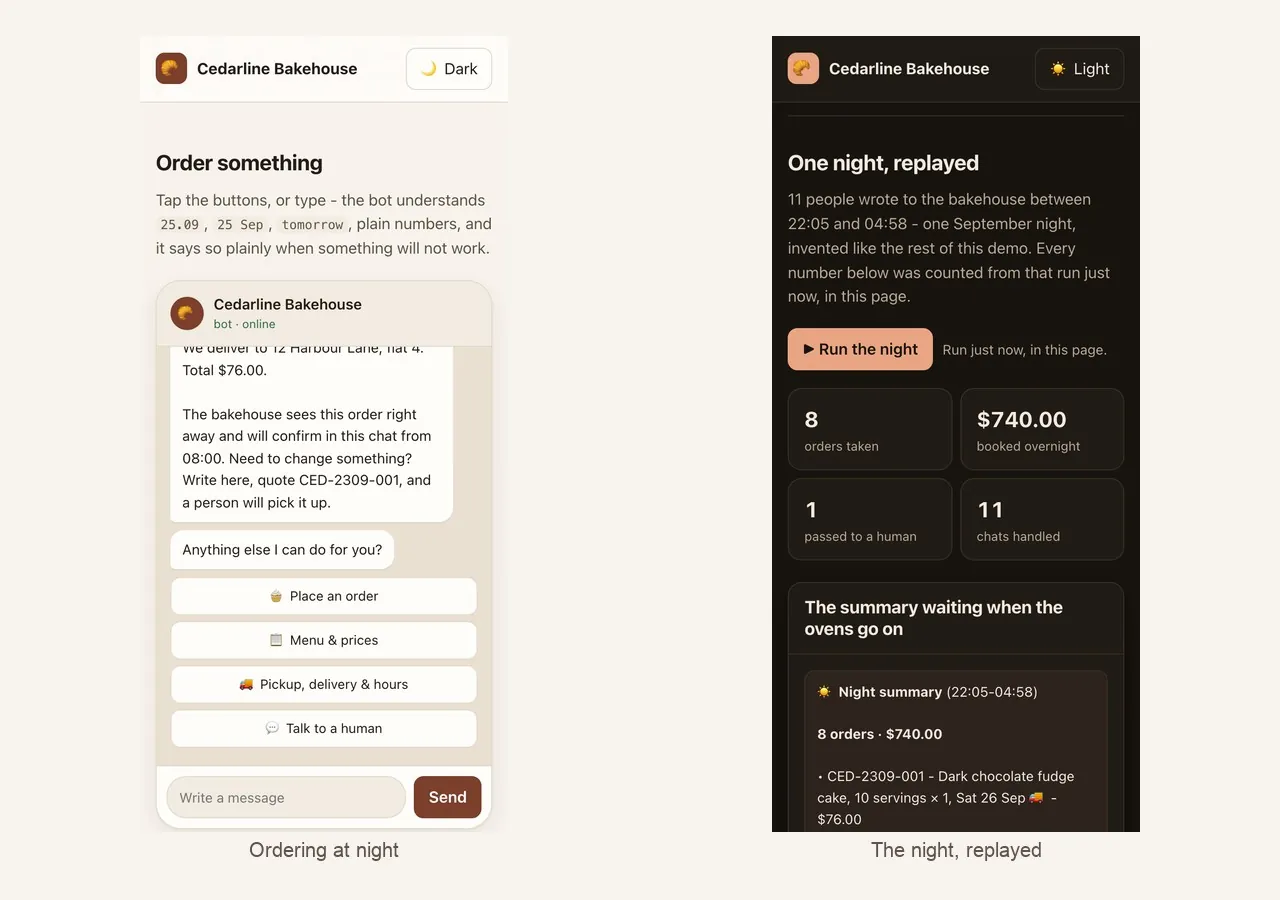
Customers message the bakery on Telegram at night too, while the owner sleeps. The bot replies right away, so each customer places an order the moment they decide to buy.
The demo replays one such night in full, from the first customer message to the owner's morning summary.
The bot takes every order through to confirmation, one question at a time. First it asks for the menu item, the number of servings and the date. Next it asks about delivery or pickup, the address and contact details, so the bakery has everything the order needs. At the end, the customer gets a confirmed order with a number, so they know the order is in.
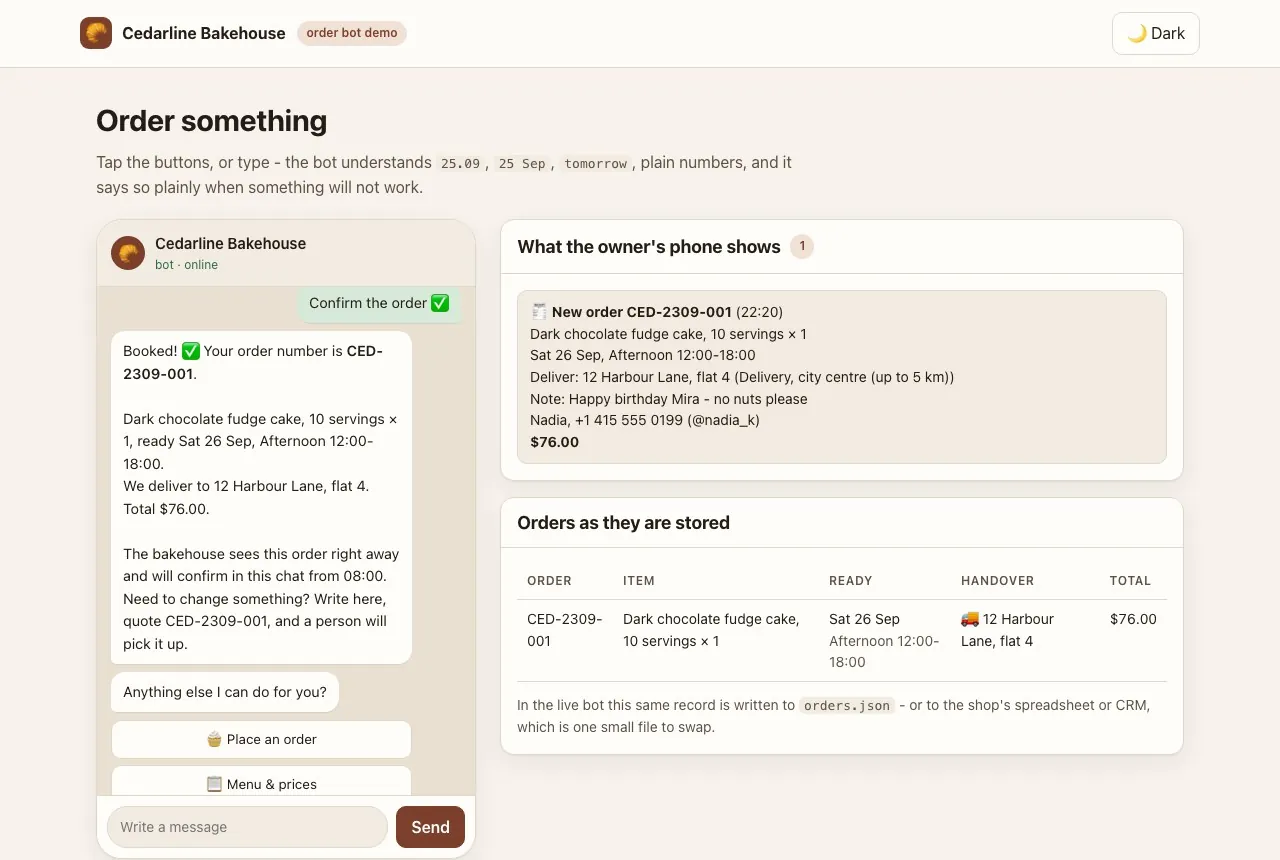
The bot knows the bakery's menu and rules, so it accepts only orders the bakery can fulfill. A cake needs 48 hours, a pastry platter 24 hours and bread 12 hours. Monday is the bakery's day off. At checkout, the bot applies the delivery zones, the delivery fee and the minimum order. When a customer asks for a cake tomorrow, the bot explains the lead time in plain words. It then offers the nearest dates that work.
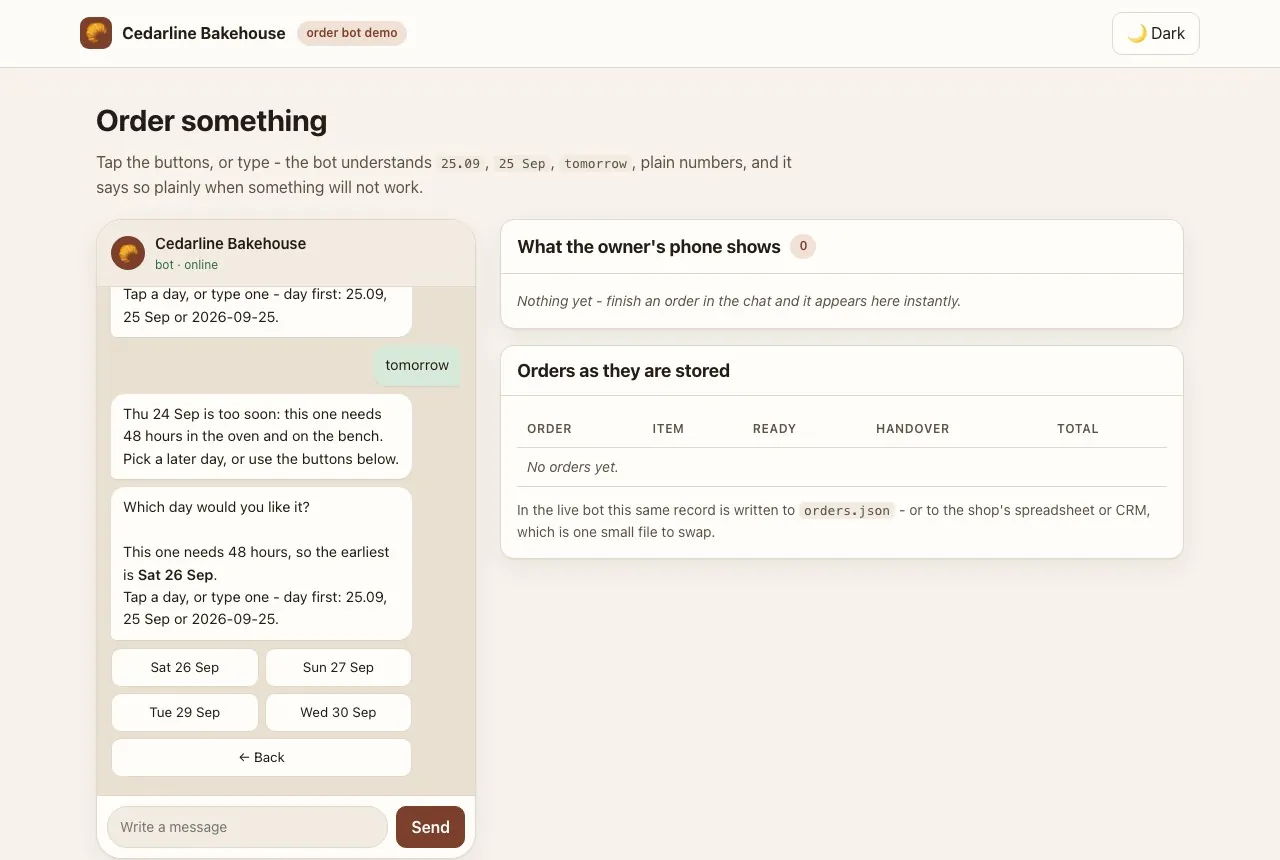
The bot also understands customers who type instead of tapping buttons. It reads typed dates such as "25.09", "25 Sep" and "tomorrow" correctly. The customer can go back a step and change an earlier choice, so ordering stays easy. Questions outside an order go to a person.
The owner starts the morning with finished orders. Each new order reaches the owner's phone the moment it is placed, so the order list is always at hand. A summary of the night arrives in the morning, with orders, dates and totals. Customers who need a personal reply are marked separately in the summary.
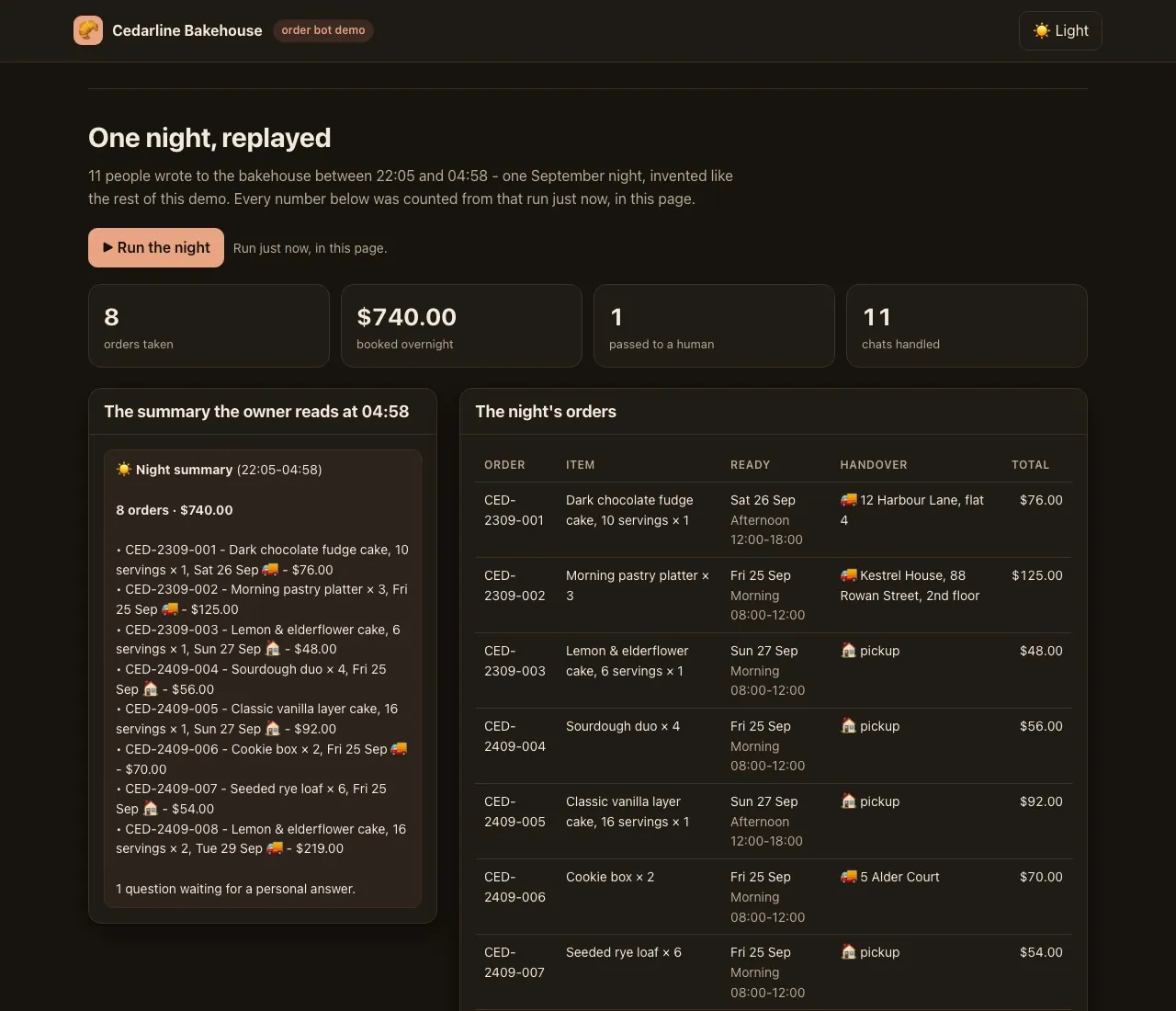
The night in numbers: between 22:05 and 04:58, the bot handled 11 chats that became 8 orders worth $740. Every one of the 11 chats got a reply that same night. The bot passed one question to a person. The page recalculates every figure each time it opens, so each one comes straight from the bot's work.
The demo runs entirely in the browser, so you can open it with no installation or account. The page runs the bot's real code. An automated test makes sure the page and the code always match. The bot uses no third-party libraries, so it needs no library updates. Each order is saved to the list exactly once. The Telegram access key is stored in a separate file, so it stays out of the code and the logs. All 64 of the bot's automated tests pass.
To go live in Telegram, the owner creates an access key for the bot. From then on, the same code that runs in the demo runs the bot in Telegram.
In a real project, the bot knows your menu and prices. It follows your lead times and delivery zones. Orders go wherever you want them. A Telegram order bot costs $300 to $450. The build takes 5 to 7 days. The first step costs $100. It covers the script and the first command. You pay in stages, each one after you approve it. A quote holds for 7 days. Work starts 2 business days after your confirmation. Support after launch costs $150 a month. It includes up to 6 hours of work. Replies to support requests come within one business day. You can cancel support month to month. The bot is built in Claude Code, Anthropic's tool for programming with AI. I have used Claude Code since June 2025. AI writes the first draft of the code. I run every check and test myself before handover.
Your order includes a free first month of support, with one bot check and up to 30 minutes of edits. This applies if you confirm the quote within 7 days.